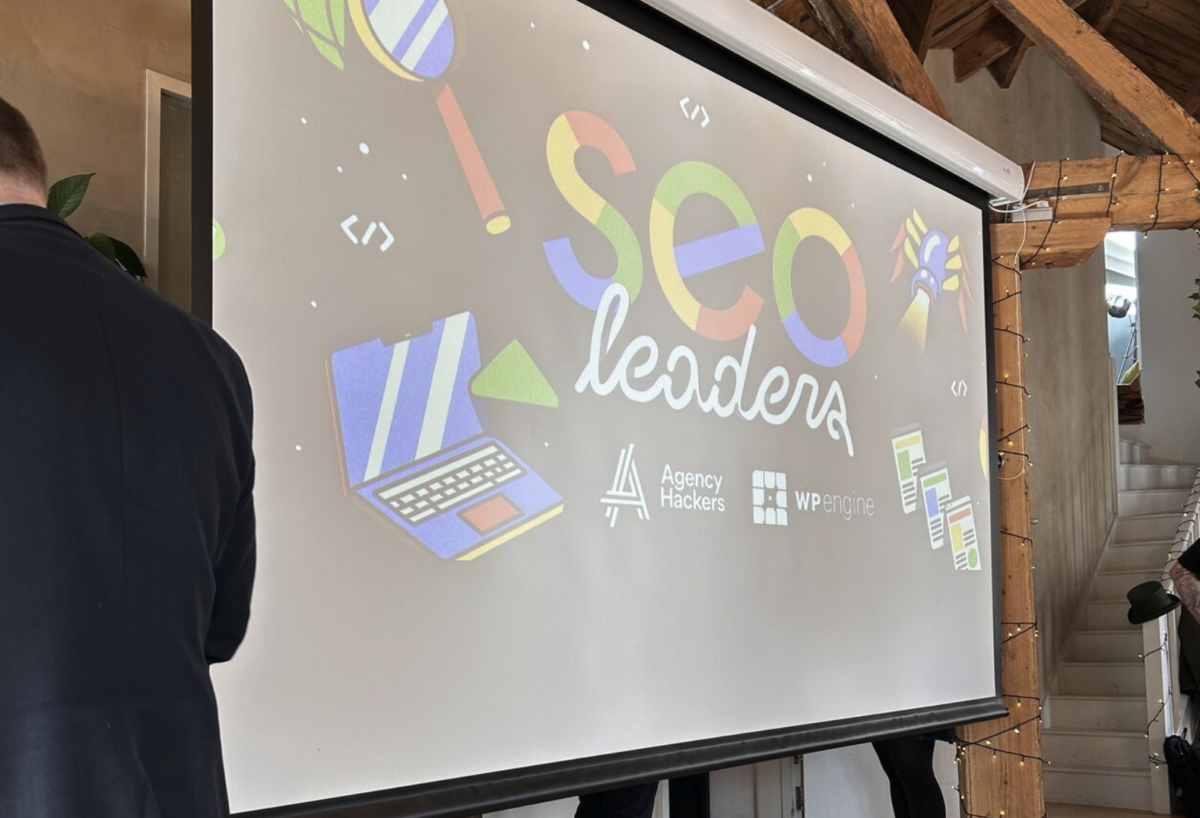
Last week I had the pleasure of speaking at the Agency Hackers SEO Leaders event in London.
My talk was called “Architecting for Two Audiences: Humans and AI‘ and if I’m honest, this wasn’t actually a topic I picked myself. But it’s something most of us are trying to work out as we build high performance WordPress websites in real time so I wanted to share it here.
Making Sense of AI + SEO
The room was full of enterprise WordPress agency owners, SEO people, and others trying to make sense of where websites and SEO and AI are heading. The conversation afterwards made one thing very clear that nobody has all the answers yet. But the shift is real and it is happening quickly and clients are sometimes confused and sometimes scared!
So this post is a short retrospective of the talk, what I shared, and where my thinking is going next.
I’ll also be expanding this into a series of posts about AI and websites and diving a bit deeper into one idea from the slides and eventually I’m hoping to turn the whole thing into a longer guide and maybe a downloadable ebook.
But for now, here it is…
First things first: I’m not an AI expert
I opened the talk with a slightly uncomfortable truth.
I’m not an AI expert.
And frankly, very few people are.
Right now there is an enormous amount of conflicting information about:
- AI search
- LLM discovery
- AI summaries
- Optimisation for bots
- Optimisation for humans
For agencies especially, this moment feels familiar. We’ve seen shifts like this before with:
- Mobile-first design and responsive websites
- Technical SEO changes and things like Core Web Vitals
The difference now is that the thing consuming your websitecontent is changing.
The web now has two audiences
Traditionally, websites were built for one audience.
People.
Design, UX, copywriting, accessibility, performance and SEO were all ultimately about serving a real flesh and blood human visitor.
Now there are two audiences interacting with websites:
- Humans
- AI systems
These AI systems are not all the same either.
In the talk I split them into three broad categories.
1. AI conversations
These are systems like ChatGPT, Claude, Gemini and others where users ask questions in natural language.
2. AI summaries
These summarise the web for the user directly in the search results. In some cases the user may never click through to the website at all because of these new summaries.
3. AI discovery
The AI “algorythams” systems are increasingly discovering, reading and structuring the web differently from traditional crawlers. They are extracting more complex information and relationships and context rather than simply indexing pages.
In other words, they are building their own internal understanding of the web based on what’s out there that is different to how classic Google search results would work.
The AI meta tag
I threw this into the mix during the talk to convey how difficult this new shift has been perceived:
<meta name="ai" content="yes">This is obviously a joke and unfortunately, there is no magic tag we can add to make our websites “AI friendly”.
But the joke highlights a real pain point because for years SEO has been about understanding:
- How search engines crawl
- How they index
- How they rank
- How they “read” your site
Now we also have to consider:
- How the AI LLMs read and understand information
- How and why they summarise content
- How they decide what is trustworthy and why that matters
This is still a new and confusing area for website owners and builders but what we do know is that the structure and clarity of website content is becoming increasingly important.
The good news is that “good” websites already help
One reassuring takeaway from the talk was that a lot of the practices that help AI systems understand websites are the same practices that make websites better for people.
So if your site alread has:
- Clear information architecture
- Structured content (schemas)
- Semantic HTML
- Good internal linking
- Strong topical authority
- Accessible design
- Fast load times
Then you should be already on your way to being fully “AI compatible”, if we can even call it that.
Agencies are figuring this out together
Another point I wanted to emphasise during the talk is that agencies should not feel like they are behind because everyone is navigating this shift together.
Clients are asking questions like:
- Should we optimise for AI?
- Will AI replace “classic” search traffic?
- Should we change our content strategy?
The answer is that there is no single playbook yet and that it can be very different for different clients and use cases.
What this means for WordPress agencies
From my perspective as someone running a WordPress agency, the platform is still in a strong position.
WordPress has always been good at things like, structured content and page structures and taxonomies. It’s also 100% expandable and open source so we have a full community behind the scenes working towards making sure that the platform works well with AI.
In the end the challenge for agencies like ours is less about the CMS and more about how we design and structure an AI-friendly content ecosystem within the CMS and fully utilise the tools and systems that the CMS gives us.
What happens next…
This talk was really just the start of a long conversation around AI and SEO in modern terms. Over the coming months I’m planning to expend on this topic and will pull together some deeper posts covering things like:
- How AI systems “read” websites
- What “AI discovery” might mean for SEO
- Better content structure for LLM understanding
- Why information architecture (IA) is becoming critical again
- How agencies should adapt their website strategy and learn to experiment
- Tools and systems that help
Eventually I’d also like to bundle these ideas into a longer downloadable guide or ebook similar to our Custom Web Apps Guide.
If you came to the talk, thank you again for the great conversations afterwards. See you at the next one!
Want me (Kimb) to speak at your event?
If you run events for agencies, SEO teams or digital leaders and would like a talk on this topic, feel free to get in touch.
- Connect on LinkedIn: https://www.linkedin.com/in/mkjonesuk/
- Or just drop me an email [email protected] and we can have a chat.
I’m always happy to talk about the web, WordPress and the messy, confusing and interesting future of our industry.