Most WordPress sites do not fail suddenly. They drift over time.
A plugin gets added to solve one urgent problem. A page builder like Elementor or WP Bakery gets pushed further than it was meant to go. A theme is tweaked again and again. Hosting stays the same while the site becomes more important. Updates start to feel risky. The original agency moves on. Internal teams lose confidence.
A landing page needs developer help. A plugin update causes worry. A form breaks. The site feels slower. Nobody is completely sure what is safe to change.
At that point, the website may still be online. It may still look fine to visitors. It may still technically work. But behind the scenes, the team no longer trusts it. That is usually the real problem.
The symptoms are familiar
Most teams do not describe this as a WordPress issue. Instead the frustration is described as “content is difficult to update” or “small changes take too long” or “we need a developer to do x or y, why can’t we do that?”.
This happens over time and eventually the site has become harder to understand, harder to support and harder to improve.
This is where WordPress support and growth plans become important, but support alone is not always enough. If the site is already fragile, you often need to understand what is causing the friction before committing to a long-term support route.
A redesign might fix the surface, but not the system
When a website becomes painful to manage, the obvious answer is often a redesign or a rebuild it.
Yes, a site may need a better visual direction, clearer UX, nicer content, faster load times and a more modern editing experience but a redesign does not automatically fix the system underneath.
Before committing to a full rebuild, it is worth asking a more useful question:
What has actually become unreliable?
That might include the codebase, the hosting, the plugin stack, the content model, the editing workflow, the support process, or all of them together.
This is where WordPress rescue and reliability services are often the better starting point. The goal is not to panic rebuild. The goal is to understand what has gone wrong, what can be stabilised and what the right next step should be.
Reliability means more than just uptime and page speed
A reliable WordPress site is not just a site that stays online or loads fast. It has to be stable, understandable, safe to update and easier to improve and manage.
A reliable site gives your business confidence they can promote the services or products they need to without massive headaches. And if those headaches exsist, then you probably need help.
Reliability matters because websites are rarely JUST websites anymore. They are probably connected to CRM systems, campaigns, analytics, online sales, ticket and event platforms, forms and quizes, AI tools, APIs, gated content, membership sections. No ‘website’ these days is JUST a website.
The Rainbird example
Rainbird, an AI and automation company, came to Make Do with a WordPress site that had become increasingly difficult to manage.
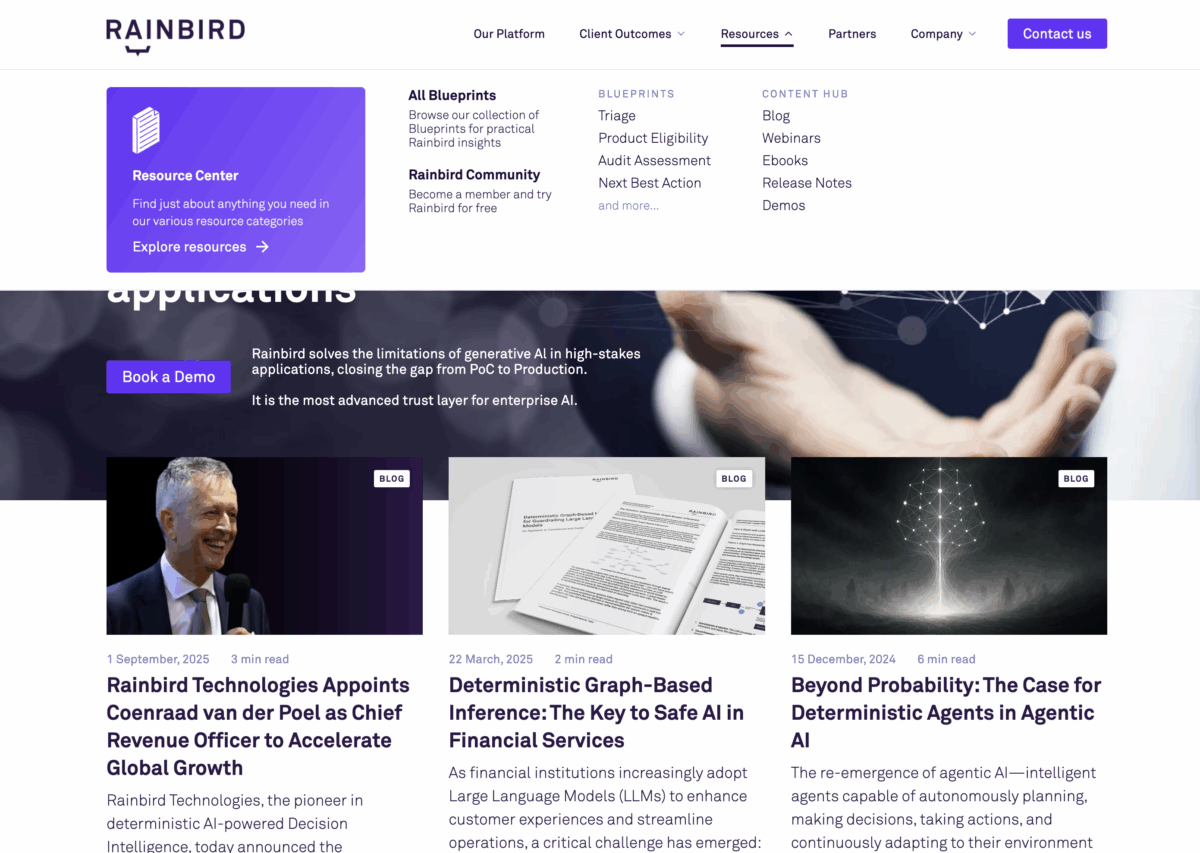
Their existing Elementor-based setup had become practically unusable. Previous updates and accumulated complexity had left the system unstable, difficult to edit and unreliable for the marketing team.
This is exactly the kind of situation where jumping straight into a rebuild can feel tempting. But in practice, the right route was more measured and slow.
Make Do supported the existing site, helped keep things moving, and worked with Rainbird until it became clear that the old setup was no longer the right foundation. At that point, a full rebuild became the sensible decision.
The replacement was not just a new design. It included a structural refresh, improved information architecture, better page types, clearer navigation, CRM integrations, improved tracking, a more stable hosting setup and a suite of bespoke Gutenberg blocks that gave editors much better control.
Read the full Rainbird case study here and you’ll see that the rebuild worked because the problem had been understood properly first.
Sometimes the right answer is to get help
Sometimes the site is fundamentally sound, but it needs more than just a DIY approach. As a site grows you need better maintenance, safer updates, clearer ownership and a more structured improvement plan.
That is where WordPress support and growth plans can give teams the ongoing help they need so they can ‘set and forget’ their website platform and carry on with the important work needed to grow their business.
And at Make Do, good support is not just reactive ticket handling. It is a way to keep your sites growing and moving, reduce risk and make steady improvements without every request becoming a new project.
Sometimes it’s hosting (it often is)
Sometimes the hosting setup is part of the problem. The site may have outgrown its environment. Backups may be unclear. Staging may not be reliable. Caching may be misconfigured. Server resources may be stretched. Nobody may be monitoring the things that matter. Why isn’t it working? Maybe it was poor choices made years ago and maybe you can get a cheaper more reliable service by asking our team for help.
In those situations, WordPress hosting and migrations are a huge part of your reliability conversation.
That does not ALWAYS mean moving host. Sometimes the current setup can be improved. Sometimes the existing provider is fine, but the configuration needs work. Sometimes a migration is the safest route.
When the right answer is a rebuild
There are also times when a rebuild is the right answer. Like it the current platform is too just too outdated and fragile, too limited or too expensive to keep patching, a new build may be the most sensible route.
A rebuild should not just replace the old site visually. It should fix the underlying issues that made the old site hard to manage in the first place. That is why website and web app development should be planned around long-term maintainability, not just launch.
The best rebuilds create a stronger foundation: clearer templates, better content structure, safer integrations, a better editing experience and a support model that keeps the site healthy after launch.
The WordPress 5-Day Reliability Sprint
The WordPress 5-Day Reliability Sprint is designed for teams who know something is not right, but are not sure what the next step should be. It is for existing WordPress sites that have become slow, fragile, risky to update or difficult to improve.
In five focused days, Make Do reviews the current setup, identifies key risks, makes practical fixes where possible and recommends the clearest route forward.
Need Our Help?
If your WordPress site has become slow, fragile, risky to update or hard to improve, start with our WordPress 5-Day Reliability Sprint.
What we look at
We review the WordPress setup, plugin stack, hosting, performance, security, update process, editing experience, theme structure, integrations and known pain points.
The aim is not to produce a vague audit that sits in a folder it is to to help your team understand what is making the site hard to manage and what should happen next.
Sometimes there are practical fixes that can be made quickly. Sometimes the biggest value is creating a clear plan. Sometimes the review confirms that bigger work is needed.
All of those outcomes are useful because they replace uncertainty with direction.
Request a WordPress Reliability Sprint
If your WordPress site has become slow, fragile, risky to update or difficult to improve, start with our WordPress 5-Day Reliability Sprint.
We will review the current setup, identify the biggest risks, make practical fixes where possible and recommend the clearest route forward.